Towing a Travel Trailer with a Ram TRX: What to Actually Expect
TRX is rated to tow 8,100 lb, but trailer tongue weight and payload math shrink that number fast for a real travel trailer. Here's how to figure out what actually fits within the truck's limits before you shop for a camper.
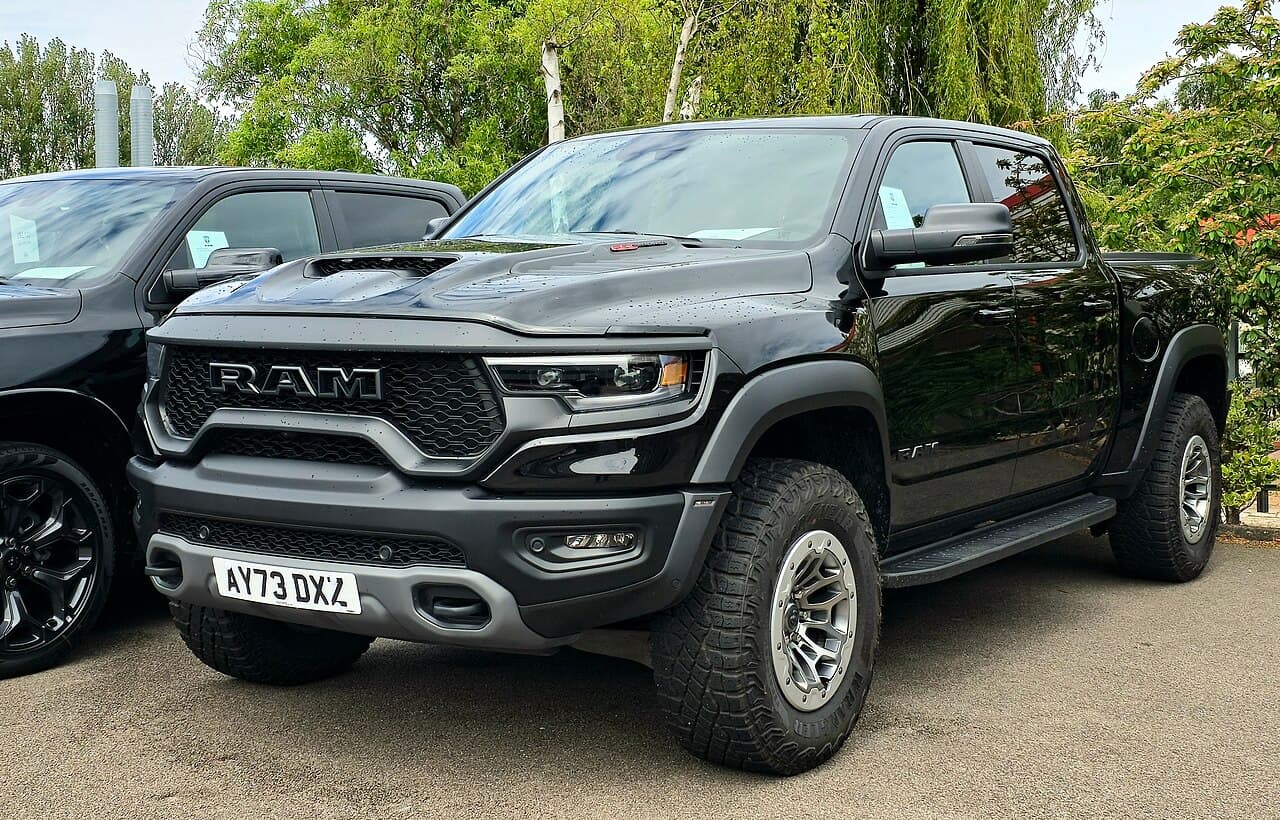
TRX's factory tow rating is 8,100 lb, but almost nobody buying a travel trailer actually gets to use all 8,100 of it. The real limit on most loaded TRX setups is the 1,310 lb payload capacity, not the tow rating, because tongue weight, passengers, and gear all eat out of that same payload number before the trailer's total weight even enters the conversation. Figure out your tongue weight and your payload math before you fall in love with a floor plan.
This applies to the 2021-2024 Ram 1500 TRX. The 2027 Ram 1500 SRT TRX shares the same basic 6.2L supercharged HEMI architecture but has been in customer hands for only a couple of weeks, so there is no published tow or payload figure from us to cite for it yet and no real-world trailer experience to draw on. If you are cross-shopping the new truck, treat everything below as a 2021-2024 TRX discussion until Ram publishes final numbers for the newer generation.
The two ceilings, and why payload usually hits first
Ram rates the Ram 1500 TRX at a maximum of 8,100 lb for towing and 1,310 lb for payload. Both are factory maximums achieved under a specific configuration (typically a lighter-optioned truck with two occupants and no aftermarket weight), not a number every TRX on a dealer lot is guaranteed to hit. A loaded 2021 with the Final Edition's extra equipment, bigger wheels, or a bed cover eats into that 1,310 lb before you've hooked up anything. Check your truck's actual payload off the yellow door-jamb sticker, which reflects that specific VIN's build weight, not the press-release max.
We've written the full breakdown of each number separately: see Ram TRX Towing: What It Can Actually Pull for the tow-rating mechanics, and Ram TRX Payload: What 1,310 Pounds Actually Buys You for the payload side. This piece is about where the two numbers collide once you put a travel trailer behind the truck.
Here's the collision in plain terms. Tow rating tells you how much trailer the truck can pull. Payload tells you how much weight can sit on the truck itself, and tongue weight (the downward force the trailer's hitch puts on the truck's rear axle) counts against payload, not against the tow rating. On most travel trailers, a loaded TRX runs out of payload well before it runs out of tow rating.
The tongue weight math, worked through
Tongue weight on a conventional (non-fifth-wheel) travel trailer typically runs 10-15% of the trailer's loaded weight. That is a general rule of thumb across the towing industry, not a TRX-specific figure, and it varies by how the trailer is loaded, where the axles sit, and whether the holding tanks are full.
Run the numbers on a trailer that sits comfortably under TRX's 8,100 lb tow max, say a 6,000 lb loaded travel trailer. At 12% tongue weight (a reasonable mid-range estimate), that's about 720 lb sitting on the truck's hitch. Now add what else rides in the cab and bed: two adults at roughly 350-400 lb combined, a cooler and camping gear, maybe a weight-distribution hitch head itself (those typically run 60-100 lb on their own). You're at 1,100-1,200 lb of payload used before you've accounted for a full tank of gas adding more, or a third passenger, or a loaded bed.
That leaves very little daylight under the 1,310 lb ceiling. A bigger trailer, a family of four, or a loaded truck bed pushes a 6,000 lb trailer past what the truck can legally and safely carry, even though 6,000 lb is nowhere near the 8,100 lb tow max.
The math gets worse, not better, as the trailer gets heavier, because tongue weight scales with trailer weight. An 8,000 lb trailer at 12% tongue weight is 960 lb on the hitch alone, which leaves roughly 350 lb for everything and everyone else in the truck. That is one adult and a weekend's worth of gear, not a family and a loaded bed.
A simple way to check your own numbers
- Find your truck's actual payload capacity on the yellow door-jamb sticker (the specific number for your VIN, not the press-release max of 1,310 lb).
- Weigh or estimate your trailer's fully loaded weight, including water, propane, and whatever you'd actually pack for a trip, not the dry weight on the trailer's spec sheet.
- Multiply that loaded trailer weight by 0.10 and by 0.15 to get a tongue weight range, then use the higher end if you're unsure how the trailer is loaded.
- Add passengers, cargo, and any hitch hardware weight to that tongue weight figure.
- Compare the total against your truck's actual payload number. If it's close or over, the truck cannot safely carry that setup, regardless of what the tow rating says.
- Separately confirm the trailer's loaded weight stays under 8,100 lb, with margin, since you also want headroom for a loaded truck bed and weight-distribution hardware.
If you're shaky on any of this before you buy a trailer, the used Ram TRX buying guide and the dimensions piece on TRX size and towing-related fit are worth reading alongside this one, since garage clearance and payload both factor into what trailer actually works day to day.
How the suspension and wheelbase affect towing feel
TRX runs a desert-tuned long-travel suspension and sits on a shorter wheelbase than most half-ton crew cabs configured for towing. In general terms, a shorter wheelbase and a softer, longer-travel suspension tend to feel busier behind a trailer than a longer-wheelbase truck on a firmer, tow-oriented suspension tune. That's a general expectation for this class of high-clearance performance truck, not a measured result.
We want to be direct about what we don't know here. Nobody has published instrumented sway or stability data for towing with a TRX, and we haven't run that testing ourselves. There's no brake-fade data, no crosswind stability number, no object-lesson video we can point to with real measurements attached. Owners who tow with these trucks generally report a looser, softer feel at highway speed compared to a Rebel or Laramie with the tow package, which tracks with what the suspension tune is built for (desert running, not interstate trailer stability), but that's a qualitative read, not a number.
The practical takeaway: a properly set up weight-distribution hitch and sway control are not optional extras on this truck, they're closer to mandatory if you're towing anything with meaningful tongue weight. And staying well under both the tow and payload ceilings gives you margin on a truck whose suspension was not primarily engineered around trailer stability the way a heavy-duty or tow-focused half-ton's was.
What towing does to fuel economy
Towing will meaningfully cut into whatever mileage you're getting unloaded, full stop. We're not going to hand you a towing-specific MPG number here, because nobody has published a reliable, controlled figure for towing with this truck, and anything we wrote would be a guess dressed up as a spec. For what the EPA actually rates the TRX at unloaded, and the honest gap between that rating and real-world driving, see Ram TRX MPG: What the Official Ratings Say and What They Do Not. Expect towing to pull meaningfully below whatever baseline number you see there; budget your fuel stops accordingly and don't assume the unloaded figure carries over.
What trailer class actually makes sense
Given the payload math above, a TRX works best paired with a lighter travel trailer, something that leaves real margin on both ends rather than chasing the 8,100 lb ceiling. As a rough target: a loaded trailer weight in the 4,500-5,500 lb range leaves enough payload headroom for passengers, gear, and a weight-distribution hitch without getting uncomfortably close to 1,310 lb. That's a small-to-mid-size single-axle or light tandem-axle travel trailer, not anything approaching a full-size bunkhouse unit.
Trailers over roughly 6,500 lb loaded start demanding the kind of tongue-weight-versus-payload discipline described above, and trailers in the 7,500-8,000 lb range leave almost no margin at all once two people and a cooler are in the truck.
The one calculation nobody can do for you is the one that matters most: weigh your specific loaded trailer, calculate the actual tongue weight off that number, and check it against your specific truck's door-sticker payload before you sign for either the truck or the trailer. The factory maximums describe a ceiling achieved under ideal conditions, not a guarantee for your build.
The short version
- TRX's 8,100 lb tow max is rarely the binding limit for a travel trailer; the 1,310 lb payload max usually is, once tongue weight, passengers, and gear are added up.
- Tongue weight typically runs 10-15% of a trailer's loaded weight, a general towing rule, not a TRX-specific figure. Do that math before you shop trailers.
- There is no instrumented sway or stability data for towing with a TRX. General expectation, not measured fact: shorter wheelbase and desert-tuned suspension likely feel looser towing than a standard tow-package half-ton.
- Towing will cut meaningfully into the unloaded mileage described in Ram TRX MPG: What the Official Ratings Say and What They Do Not; no honest towing-specific number exists to quote.
- Target a loaded trailer in the 4,500-5,500 lb range for real margin, and always weigh your actual loaded trailer and tongue weight against your truck's door-sticker payload before buying.