Ram Rho vs. Ford Raptor: How Ram's New Six-Cylinder Stacks Up
Ram's twin-turbo Rho and Ford's EcoBoost Raptor are chasing the same half-ton performance buyer, but they get there with very different engines and price points. Here's how they actually compare, and which one makes more sense depending on what you want the truck for.
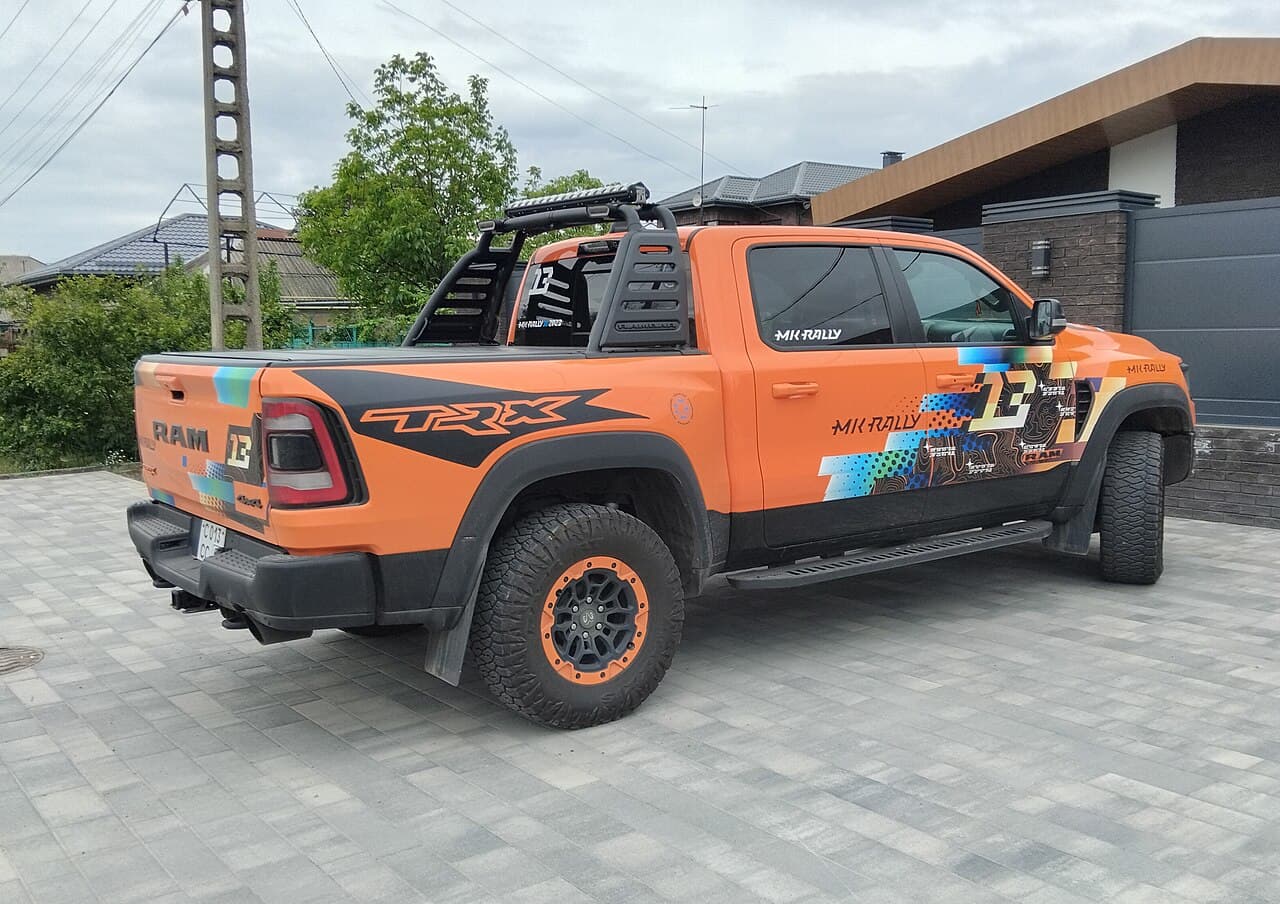
The Ram Rho is Ram's turbocharged six-cylinder answer to a question nobody was really asking Ram to answer with a six, and the Ford Raptor is the truck that created this category in the first place. They compete for the same buyer's attention but they are not the same truck under the skin, and one of them has been on sale long enough to have a reputation while the other has been on sale for a matter of months. This is a spec and mission comparison, not a reliability verdict, because the Rho does not have an ownership record yet.
Where each one sits in its own lineup
Inside Ram's own truck lineup, the Ram 1500 Rho sits below the supercharged Ram 1500 TRX. It is not a TRX with a smaller engine bolted in. It is Ram's attempt to give buyers most of the performance feel of the V8 truck at a lower price and a lower curb weight, using a twin-turbo six instead of the supercharged 6.2L HEMI. For full pricing and spec detail on the Rho, see the Ram Rho price and specs breakdown and the plain explanation of what the Rho actually is.
Ford's Raptor occupies a similar slot below its own flagship, the Raptor R, which runs a supercharged V8 (the Predator engine shared with the old Shelby GT500) and costs meaningfully more. The standard Raptor, the one most buyers actually cross-shop against the Rho, has run a twin-turbo V6 since the current generation launched for 2021.
So the honest framing is: Rho competes with Raptor, not with Raptor R, and TRX competes with Raptor R, not with the base Raptor. Keep those pairings straight or the comparison stops making sense.
Engine architecture: twin-turbo six versus twin-turbo V6
Both trucks have abandoned superchargers for their mid-tier performance trim. That is the more interesting story than either horsepower number.
The Rho runs the High-Output version of Ram's Hurricane engine, a 3.0L twin-turbo inline-six, rated at 540 hp and 521 lb-ft on Ram's own published figures. There is no supercharger and no belt-driven blower whining under the hood the way there is on a TRX. Power comes from twin turbochargers spooling off exhaust gas, which is a different power delivery character entirely: more midrange punch built by boost pressure, less of the linear, always-on shove a supercharger gives you.
The Raptor runs Ford's 3.5L EcoBoost, also twin-turbo, also a six, but a V6 rather than an inline-six. Ford's own rating puts it at 450 hp and 510 lb-ft. That is meaningfully less peak horsepower than the Rho's Hurricane, though the Raptor's torque curve was tuned from day one for low-speed desert running rather than straight-line pace.
Confirm both of these against Ram's and Ford's current spec sheets before you quote them anywhere that matters. Manufacturers revise ratings mid-cycle, and the number that was true at launch is not guaranteed to be the number on this year's window sticker.
| Ram Rho | Ford Raptor | |
|---|---|---|
| Engine | 3.0L twin-turbo Hurricane I6 (High-Output) | 3.5L twin-turbo EcoBoost V6 |
| Output (mfr rating) | 540 hp / 521 lb-ft | 450 hp / 510 lb-ft |
| Slots below | Ram TRX | Ford Raptor R |
| Built primarily for | Quick, comfortable street truck | High-speed desert running |
What each truck is actually built for
This is where the spec sheet stops telling the whole story.
The Rho reads like Ram built it for someone who wants TRX-adjacent power and a sportier truck to drive every day, without paying TRX money or living with TRX fuel bills. It keeps more of the standard Ram 1500's on-road manners: a chassis tuned for comfort and control on pavement first, off-road capability as a strong secondary trait rather than the whole reason the truck exists.
The Raptor was built the opposite way around. Ford's engineers started with desert racing in mind: long suspension travel, dampers designed to soak up repeated high-speed impacts without fading, and a wider track than the standard F-150 to keep the truck stable at speed over rough terrain. The V6 in the Raptor is there to move the truck fast enough to use that suspension, not to win a stoplight drag race against a Hurricane six.
Neither approach is wrong. They are different jobs. If your version of "performance truck" means a quick daily driver that can still handle a trail without drama, the Rho's brief matches you better. If your version means running whoops and washboard at speed without the truck beating itself (or you) to pieces, the Raptor's brief is the one built for that specifically, and has been refined across multiple generations to do it.
Positioning and price
Neither truck's exact transaction price is worth locking into a fixed number here, because incentives, trim packages, and options move both figures constantly. What is worth stating plainly: the Rho is positioned as the more affordable performance Ram, priced below the TRX, and the Raptor is positioned as the more affordable performance F-150, priced below the Raptor R. Neither is a budget truck. Both ask a real premium over a base half-ton for the performance hardware.
For the Rho, current listings and dealer pricing are moving fast enough that a snapshot number would be stale by the time you read it. Check the live Ram Rho market listings for what dealers are actually asking right now rather than trusting a number printed on a launch-day press release.
The used-market angle, and why it does not apply to the Rho yet
The Ram TRX has enough used inventory now that pricing patterns by model year are visible and worth publishing. A 2021 TRX is averaging in the high $60,000s on the used market right now, climbing toward the low $90,000s for a 2024, and that spread tells you something real about depreciation and mileage.
The Rho does not have that history yet. It is too new for a used market to exist in any meaningful sense, and there is no ownership-cost or reliability data to report on it, positive or negative. Anyone telling you otherwise this early is guessing. That is also true of the 2027 Ram SRT TRX, which has been in customer hands for weeks, not years.
Which one actually fits you
If your truck's job is mostly pavement, with off-roading as something you do a few weekends a year, the Rho's on-road manners and lower price than the TRX make it the more sensible six-cylinder performance pick, and it beats the Raptor on that same ground for less money.
If your truck's job is genuinely running trails and desert terrain at speed on a regular basis, the Raptor's suspension architecture and racing pedigree are still doing something the Rho was not built to do, and no horsepower number changes that.
If you are trying to place either of these against the supercharged V8 trucks in this comparison, the honest TRX-versus-Raptor comparison and the three-way TRX vs Rho vs Raptor breakdown cover that ground directly.
The short version
- The Rho's twin-turbo Hurricane six (540 hp / 521 lb-ft, per Ram) out-powers the Raptor's twin-turbo EcoBoost V6 (450 hp / 510 lb-ft, per Ford) on paper, but the Raptor's suspension and desert pedigree are built for a different job entirely.
- Rho slots below TRX in Ram's lineup; Raptor slots below Raptor R in Ford's. Compare Rho to Raptor, not to Raptor R.
- Choose the Rho if most of your driving is on-road with occasional trail use and you want TRX-adjacent power for less money. Choose the Raptor if high-speed off-road running is the actual use case.
- The Rho has no long-term reliability or ownership-cost record yet. Treat every claim about its durability, including this one, as unverified until real owners have logged real miles.