Living With a Ram TRX Every Day
Plenty of people ask whether a TRX works as a daily driver before they ask what it costs. It is the right question in the wrong order - here is what daily use actually involves.
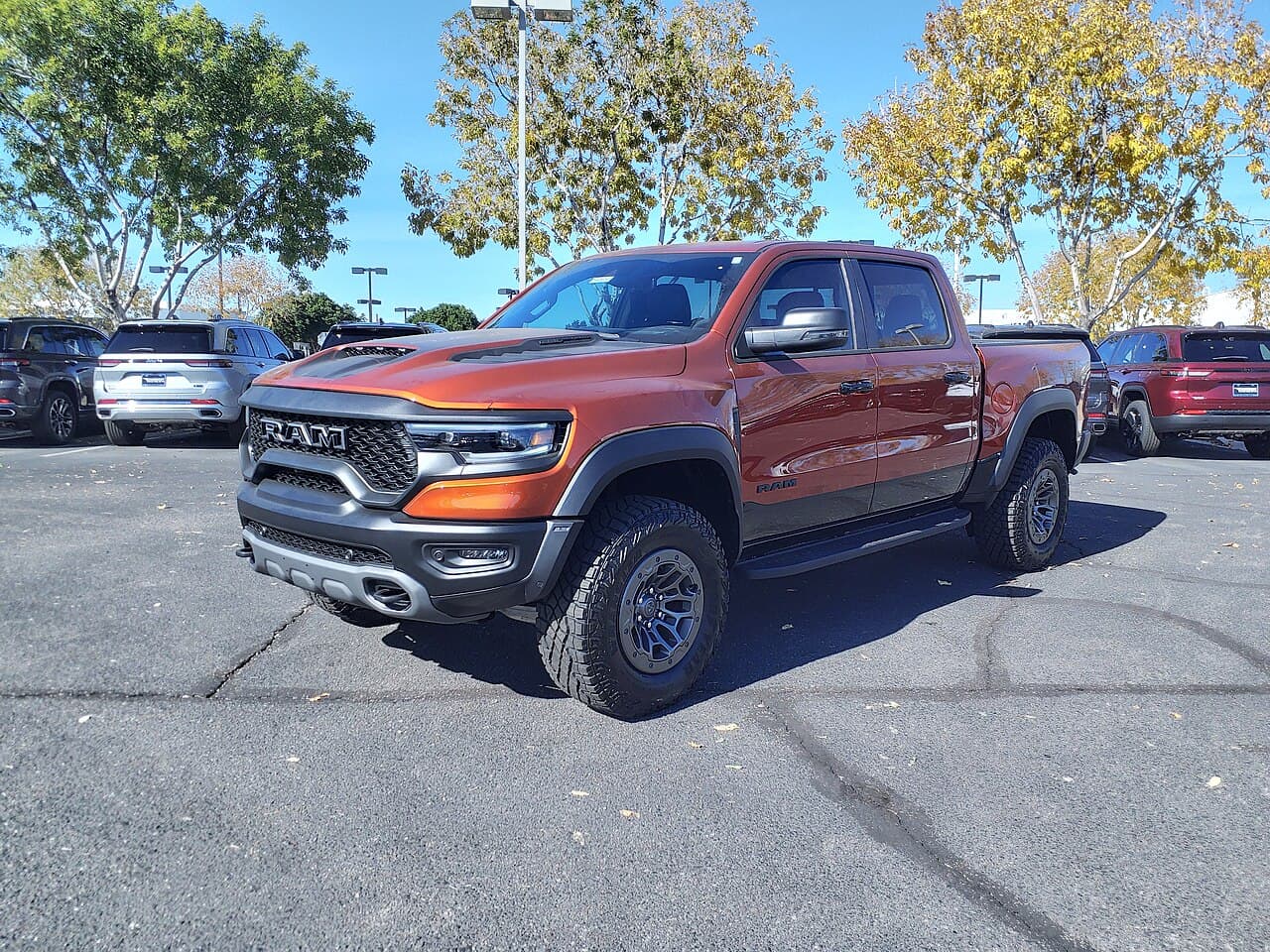
The honest answer is yes, a Ram 1500 TRX works as a daily driver, but it works the way a performance car works as a daily driver: everything the spec sheet made exciting also makes Tuesday morning slightly harder. You will spend more on fuel and tires than you would in a Ram 1500 Rebel, you will think twice before parking it in a tight downtown garage, and the ride on broken pavement is firmer than most trucks in this price bracket. None of that is a defect. It is the tradeoff for 702 horsepower and 35-inch tires, and it is exactly why Ram built the Ram 1500 RHO for buyers who want most of the attitude without the daily cost.
This piece is about the friction, not the fantasy. If you already know the numbers and just want the case for and against, here it is.
The width and the parking lot you actually have
The TRX is not subtly wider than a regular Ram 1500. The factory fender flares and the wide track needed to clear a 35-inch tire push the body out past a standard half-ton, and you feel it the first time you split two painted lines in a grocery store lot or thread a parking garage built for sedans. Most owners adapt within a week and start parking at the back of the lot on instinct. If you drive daily in a dense city center with underground garages that post height and width limits, measure your specific garage before you buy. This is a truck that wants a driveway or a wide surface lot, not a downtown structure.
What it actually costs to keep fed
The 2021-2024 Ram 1500 TRX carries an EPA rating of 10 mpg city, 14 mpg highway, 12 mpg combined, according to figures published at fueleconomy.gov for those model years. The 6.2L supercharged HEMI did not change output or fuel mapping across that run, so the rating holds for all four model years. It also wants premium fuel, which adds another few cents per gallon on top of the volume you are already burning.
Run the math on the factory tank, listed at 33 gallons, and the EPA numbers put a full tank at roughly 330 miles of theoretical range around town and closer to 460 on the highway, before you account for the reserve nobody actually drains. In practice that means more fuel stops than a Rebel or a Laramie on the same commute, and a noticeably bigger number every time you fill up.
The Ram 1500 SRT TRX has not published an EPA figure we are confident enough to print here, and the added 75 horsepower and 30 lb-ft over the outgoing truck are not the kind of change that typically improves a combined rating. Until fueleconomy.gov lists the 2027 number, treat the outgoing truck's rating as the closer starting point than any optimistic guess.
If the fuel number alone is the deciding factor, read the honest comparison between the TRX and the RHO. The RHO trades the supercharged V8 for the twin-turbo Hurricane inline-six specifically to close this gap, and for a lot of daily drivers it closes enough of it to change the buying decision entirely.
Tires: the running cost nobody mentions until the bill arrives
Both generations ride on a 35-inch all-terrain tire as factory equipment, and that tire is doing double duty: it is part of what makes the TRX capable off-road, and it is the single most expensive consumable you will own on this truck. A 35-inch tire wears faster under a 6,300-plus-pound curb weight and 650-680 lb-ft of torque than the same size would on a lighter truck, especially if your daily includes a lot of stop-and-go where the front end scrubs on tight turns.
Budget for a full set well before the tread wear bars show up. A set of four name-brand all-terrains in this size runs roughly $1,600-2,400 as an estimate, and that swings with brand, whether you need a mud-terrain for winter traction, and whether your shop can balance a 35 without extra charges for the heavier wheel and tire combination. Rotate on schedule and check the factory service manual's recommended interval for your model year rather than guessing, because uneven wear on a truck this heavy shows up fast.
Ride quality: firmer than the segment, by design
The factory adaptive dampers on both generations are tuned for high-speed desert running as much as they are for comfort, and that tuning shows up on broken city pavement. Sharp expansion joints and potholes transmit more than they would in a standard Ram 1500 Laramie riding on smaller wheels and a taller sidewall. It is not harsh in the way a stripped-out off-road buggy is harsh, but it is not the cushioned highway ride a lot of half-ton buyers expect either.
Owners who daily their trucks on rough state routes tend to either accept the tradeoff as the cost of the capability, or they start looking at the mod database for coilover and shock options that can be tuned closer to a comfort setup without giving up all the travel. That is a real path, but it is a project with a real labor bill attached, not a free fix.
Maintenance and the costs that add up quietly
Oil changes on the 6.2L cost more than a standard V8 service, mostly because of the oil volume and the labor some shops charge for the extra access panels around the supercharger. Expect to pay more than you would for a Ram 1500 Rebel's 5.7L HEMI, though the exact number varies enough by shop and region that a specific figure here would just be a guess. Brake pads and rotors on a truck this heavy also do not last as long as they would on a lighter half-ton, especially if your commute has a lot of stop-and-go.
None of this is unique to the TRX among performance trucks, but it adds up over a year of daily use in a way that a spec sheet does not show you up front.
What the warranty does and does not soften
Ram's factory powertrain warranty covers the engine, transmission, and drivetrain components for the term specified in your original sale documents, and that coverage transfers with the truck on a used 2021-2024 example within its original term and mileage. It does not cover tires, brake pads, or fuel. A TSB (technical service bulletin) is a documented repair procedure Ram issues to dealers for a known issue, not a promise of free work outside the warranty period. If you are staring at a bill for something you think should be covered, call your dealer with the VIN and ask directly what applies to your build date, because coverage details vary and a forum answer is not a substitute for that call.
Where the used market sits if you are shopping instead of already owning
If you are cross-shopping model years, the running costs above apply about equally across 2021-2024, since the drivetrain did not change. What changes is what you pay going in. Current listings on our live TRX pricing data put the average around $69,500 for a 2021, climbing to roughly $94,600 for a 2024, and a 2027 SRT TRX averaging around $110,300 on the used market against a new MSRP of $99,995 plus $2,595 destination. None of that used-market pricing changes the fuel or tire math above. A cheaper 2021 still costs the same to feed as a pricier 2024. If you want the full model-year breakdown before you buy, the used TRX buying guide covers what to check on each year, and the live market page shows what is actually listed right now rather than an average.
Who this actually suits as a daily, and who should not buy one
This truck makes sense as a daily for an owner who genuinely uses the capability on weekends, who has a driveway or a wide parking situation, and who has already budgeted for premium fuel and a tire replacement every couple of years without flinching. It does not make sense for someone shopping purely on cost per mile, or for someone whose daily is mostly tight urban parking where the width becomes a real chore twice a day.
If the honest answer for you is "I want the look and most of the capability without the fuel and tire bill," the Ram 1500 RHO exists for exactly that reason, and it is worth cross-shopping before you commit to a TRX or an SRT TRX on the strength of the spec sheet alone.
The short version
- The 2021-2024 TRX is EPA-rated at 10 city / 14 highway / 12 combined mpg on premium fuel; the 2027 SRT TRX has no published rating yet.
- Tires are the real recurring cost: budget an estimated $1,600-2,400 per set on the factory 35-inch size, more often than on a standard half-ton.
- The width and the ride firmness are real daily frictions, not defects, and they do not go away with ownership.
- If fuel and tire cost are the deciding factor, the RHO is the truck built to answer that question, not the TRX.