2027 Ram SRT TRX vs. New Ram RHO: Which New Performance Truck to Buy
Both are current-production Ram performance trucks, but they sit at very different price points and deliver power in different ways. Here's how to decide between them before you order one.
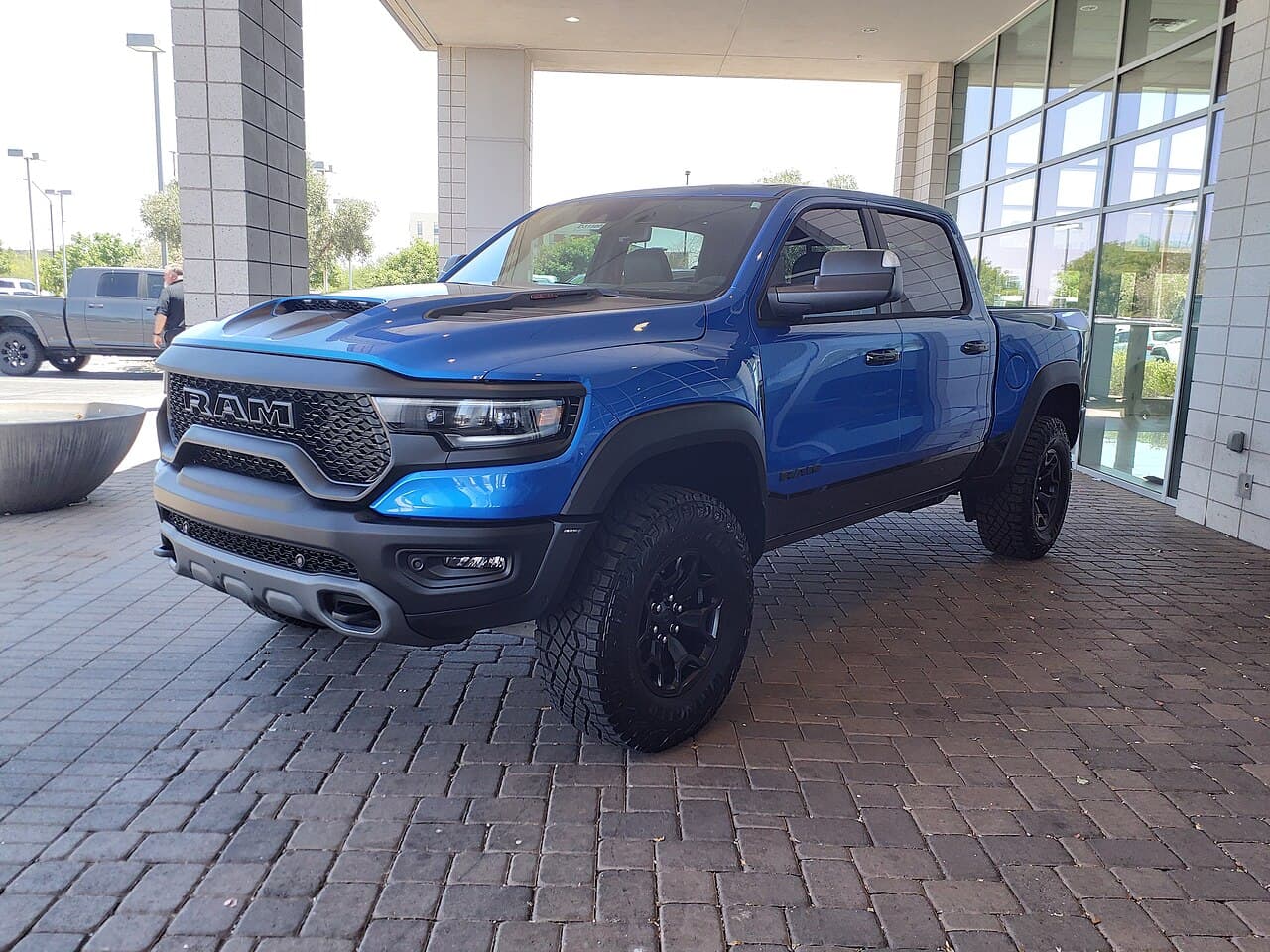
The short answer: if you want the biggest number on the spec sheet and a supercharged V8 you can feel through the seat, the 2027 Ram SRT TRX is the one to order, starting at $99,995 plus $2,595 destination for 777 hp. If you want into Ram's performance lineup for meaningfully less money with a different kind of power delivery, the Ram RHO is the truck to look at. The two are not really cross-shopped by people cross-shopping the same $20,000, because they are not aimed at the same wallet. This is a guide to figuring out which wallet is yours.
What each truck actually is
The 2027 Ram SRT TRX is the second generation of Ram's supercharged half-ton, and the first launch of the relaunched SRT performance division. It carries the same architecture idea as the 2021-2024 truck: a 6.2 liter supercharged HEMI V8 stuffed into a Ram 1500 chassis with off-road-focused suspension. The 2027 truck makes 777 hp and 680 lb-ft, a jump of 75 hp and 30 lb-ft over the outgoing 2021-2024 TRX. Production started August 3, 2026 at the Sterling Heights Assembly Plant in Michigan, the same plant that built every first-generation truck. As of this writing it has been in customer hands for roughly two weeks.
The RHO is a different animal under the hood. Rather than a supercharged V8, it runs Ram's twin-turbocharged 3.0 liter Hurricane inline-six. That is a fundamentally different power delivery, turbo lag and boost curve instead of supercharger whine and linear pull, and it is worth driving both before you decide you know which you prefer on paper. We are not going to hand you a horsepower or torque number for the RHO here. Ram has published more than one Hurricane output level across its lineup depending on trim, and the exact figures attached to the RHO nameplate are the kind of detail that is easy to get wrong by memory and easy to get right by checking Ram's own configurator or a current window sticker. Pull the RHO's official horsepower, torque, and MSRP straight from Ram's published materials or a dealer quote before you order, not from a forum post, and not from this paragraph if you are reading it a year from now and the trim lineup has shifted. Our own numbers page for the RHO tracks this, and it is the place to start: Ram RHO price and specs.
The price gap, in general terms
The SRT TRX starts at $99,995 plus $2,595 destination, so figure just north of $102,000 before any options, tax, or dealer markup. The RHO is Ram's lower-priced performance truck by design, it exists specifically to give buyers a way into Ram performance hardware without a six-figure sticker. Confirm the RHO's exact starting MSRP against Ram's current published pricing before you budget against it, since trim levels and standard-equipment lists shift year to year and we do not want to hand you a number that is stale by the time you read it. Whatever that number turns out to be, the shape of the comparison holds: the SRT TRX sits at the top of Ram's truck lineup on price, and the RHO sits meaningfully below it as the more accessible performance option. If you are cross-shopping on payment more than on spec sheet, that gap is the whole conversation.
Used-market data adds context on the TRX side that doesn't exist yet for either new truck. Live listings for the outgoing TRX generation currently average $68,532 for a 2021, climbing to $93,144 for a 2024, and the 2027 SRT TRX is already averaging $108,629 across live listings, above its own MSRP, which tells you demand is outrunning supply in the first weeks of production. There is no comparable used-market data for the RHO yet because it has not been on sale long enough to build one.
Power delivery: supercharged V8 versus twin-turbo six
This is the part of the decision that a spec sheet cannot settle for you. The SRT TRX's 6.2 liter supercharged HEMI is an old-school big-displacement V8 with a belt-driven blower on top, delivering power in a way that is immediate and linear and loud, with the exhaust note as much a selling point as the number. Our breakdown of exactly what the extra 75 hp over the first-generation truck does at the wheel is here: Ram TRX horsepower: 702 vs 777.
The RHO's turbocharged six is a smaller-displacement engine built for a different kind of efficiency and a different power curve, with boost building rather than power simply being there from idle. Neither approach is objectively better. They are different tools, and which one you want depends on whether you are buying a truck for the sound and the drama of a supercharged V8 or for turbocharged power with different displacement and different fuel economy characteristics.
Which buyer profile fits which truck
The SRT TRX buyer is the person who wants the fastest, most powerful factory Ram half-ton available, full stop, and is willing to pay six figures for it. This buyer usually already knows they want a supercharged V8, cares about off-road capability at speed (the truck is built for high-speed desert running, not rock crawling), and is comparing the SRT TRX against the old TRX on the used market or against a Ford Raptor, not really against the RHO. If that is you, our early buyer's verdict digs into whether the $99,995 starting price is actually worth it: Is the 2027 Ram SRT TRX worth $99,995?
The RHO buyer wants meaningfully more capability and presence than a base Ram 1500 without spending six figures to get it. This is the buyer cross-shopping a well-optioned Rebel or a used TRX on price, not the buyer who has already decided they need 777 hp. If your budget realistically caps out well under six figures, the RHO gets you into Ram performance hardware at a price the SRT TRX simply is not built to hit.
A third path worth naming: a clean used first-generation TRX. At $68,532 to $93,144 average depending on model year, you can land the older 702 hp supercharged V8 for less than either new truck, with the tradeoff being mileage and a used warranty picture instead of a factory one. Our full three-way breakdown, including the Raptor, covers all of this in one place: Ram TRX vs Ram RHO vs Ford Raptor, which one actually fits how you drive.
What we cannot compare yet
The 2027 SRT TRX has been on the road for about two weeks as of this writing. There is no reliability history, no long-term cost-of-ownership data, and no failure pattern to report, because none of that exists yet for a truck this new. Anyone telling you which one holds up better over 60,000 miles is guessing. We track what actually changed on the 2027 truck, mechanically and otherwise, separately from any durability claim: 2027 Ram SRT TRX: what actually changed, and what nobody knows yet. Treat any reliability comparison you see elsewhere between these two trucks the same way, as a guess dressed up as an answer.
The short version
- The 2027 SRT TRX starts at $99,995 plus $2,595 destination, makes 777 hp and 680 lb-ft from its supercharged 6.2 liter HEMI, and is the truck to buy if maximum factory power is the point.
- The RHO runs a twin-turbo Hurricane six instead of a supercharged V8 and exists as Ram's lower-cost performance entry point; confirm its current horsepower, torque, and MSRP directly from Ram before you order, since those figures were not stated here from memory.
- A used first-generation TRX (2021-2024, averaging $68,532 to $93,144 depending on year) is a legitimate third option if you want the supercharged V8 experience for less than either new truck costs.
- There is no reliability or cost-of-ownership comparison to make yet between the SRT TRX and the RHO. The SRT TRX is about two weeks into customer hands as of this writing, and anyone claiming otherwise is guessing.