2027 SRT TRX vs. Ram TRX: Towing and Payload Compared
Both trucks share the same supercharged HEMI DNA, but towing and payload numbers decide whether the extra money buys more capability or just more power. Here's what's actually confirmed and what still needs verifying on the new truck.
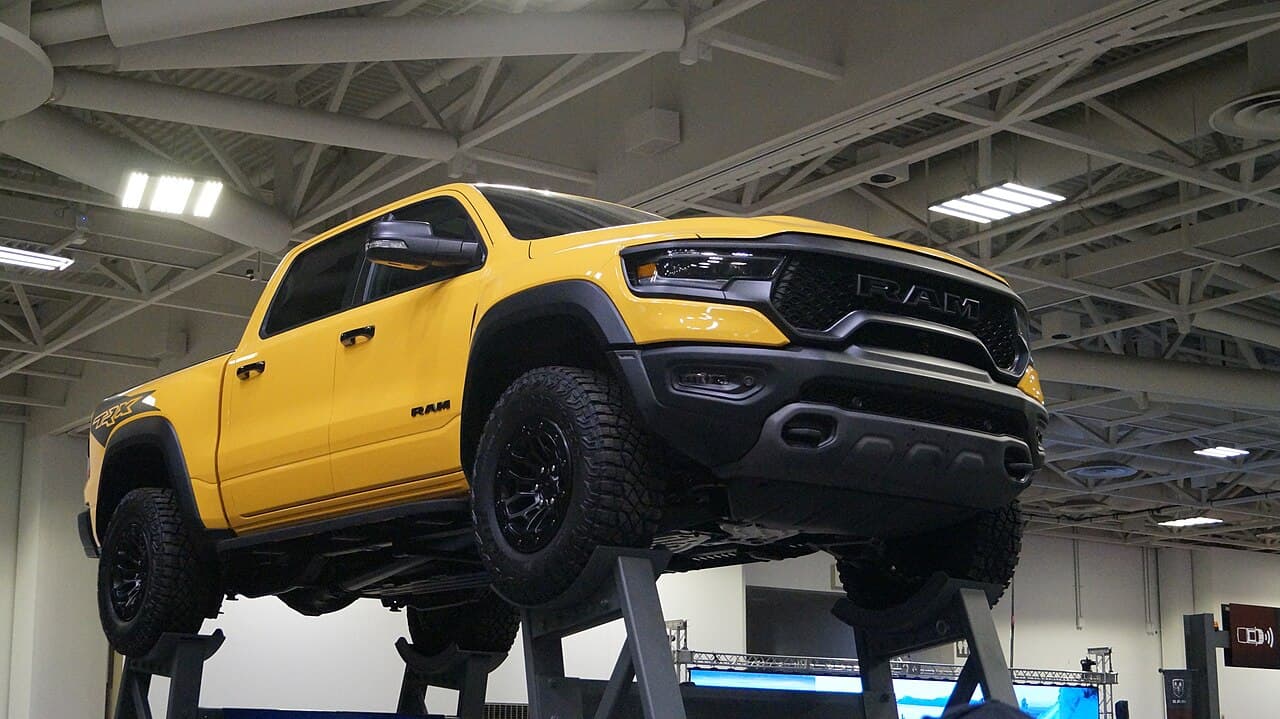
Ram's own spec sheet confirms 8,100 pounds max tow and 1,310 pounds max payload for the 2021-2024 Ram 1500 TRX. For the 2027 SRT TRX, those numbers are not yet in the verified dataset this site publishes, and until Ram posts an official tow and payload rating for the new truck, nobody should be telling you a number, including a dealer guessing from the horsepower bump.
That is the whole story in two sentences, but it is worth unpacking why 75 more horsepower does not automatically mean more capability, and what you should actually be asking before you assume the new truck tows more than the old one.
The baseline: what the 2021-2024 TRX is rated to pull and carry
The original Ram 1500 TRX, built December 2020 through February 2024 at Sterling Heights Assembly Plant, runs the 6.2L supercharged HEMI at 702 hp and 650 lb-ft, paired with the TorqueFlite 8-speed automatic. Its factory numbers are 8,100 lb max tow and 1,310 lb max payload.
Those figures already put it well behind a half-ton built for towing. A diesel-powered half-ton or a Ram 1500 with the Max Tow package will out-tow a TRX by a wide margin. The TRX was never engineered around a tow rating. It was engineered around 32-inch tires, an 18.5-inch front wheel travel desert suspension, and a top speed project. Towing and payload were constrained by what the chassis, cooling system, and tire load rating could support, not by what the engine could theoretically shove.
We cover the real-world behavior behind that 8,100 lb number, including how it actually feels at the hitch, in our towing deep dive at Ram TRX Towing: What It Can Actually Pull. If you are cross-shopping instead against a half-ton built for hauling, the Ram TRX payload breakdown is worth a read before you assume the bed and frame can do more than the sticker says.
What is confirmed, and what is not, for the 2027 SRT TRX
The 2027 Ram 1500 SRT TRX carries the same 6.2L supercharged HEMI, now rated at 777 hp and 680 lb-ft, a gain of 75 hp and 30 lb-ft over the prior truck. It starts at $99,995 plus $2,595 destination, and production began August 3, 2026 at the same Sterling Heights plant.
What is not in that list: a tow rating, a payload rating, GCWR, or any axle or frame spec that would let us calculate one. The truck has been in customer hands for about two weeks as of this writing. There is no published capacity number in the verified dataset this site maintains, and we are not going to back into one by assuming more horsepower means a proportionally higher tow rating. That is a guess, not a spec, and a guess that gets printed often enough becomes a rumor dealers start repeating as fact.
If you are shopping a 2027 SRT TRX specifically for towing or payload, call the dealer, ask for the window sticker or the Ram-published capacity chart for your exact configuration, and get it in writing before you sign anything. Model-year capacity numbers can also vary by cab, bed, and options even within the same generation, so a number pulled from a brochure for a different configuration is not reliable either.
Our running notes on what has actually changed on the new truck, separate from what is still unverified, live at 2027 Ram SRT TRX: What Actually Changed, and What Nobody Knows Yet.
Why more horsepower does not mean more towing or payload capacity
This trips up a lot of shoppers, so it is worth saying plainly: engine output and vehicle capacity ratings are not the same calculation. A truck's tow and payload numbers come from the weakest link in the whole system, not the strongest.
A few of the things that actually set the ceiling:
- Frame and chassis rating. The frame, its crossmembers, and the hitch receiver attachment point have a structural limit that has nothing to do with how much torque the engine makes. An engine that can spin the tires faster does not make the frame stronger.
- Axle and driveline ratings. The front and rear axle assemblies, half-shafts, and transfer case all carry a rated capacity. If the engine gets a power bump but the axles do not change, the drivetrain's weakest gear is still the limit.
- Cooling system capacity. Towing heavy loads at sustained highway speed loads up the engine, transmission, and power steering cooling systems. A supercharged engine already runs hot under boost; adding a trailer's worth of aerodynamic drag and rolling resistance is a different thermal problem than a standing dyno pull.
- Tire load rating and suspension travel. The TRX's wide, aggressive tire and desert-tuned suspension were chosen for off-road compliance, not maximum load carrying. A tire built to flex over whoops is not necessarily rated the same way as a tire built to carry a heavy tongue weight all day on the interstate.
- Brake system. Stopping a loaded trailer is a braking problem before it is an engine problem. A bigger engine does not improve brake rotor size or caliper clamping force.
Any one of those can cap a rating well below what the engine alone could theoretically support. This is exactly why a Hellcat-powered sedan does not tow more than a V6 pickup, and why the extra 75 hp in the 2027 SRT TRX tells you nothing on its own about whether it can pull or carry more than the 2021-2024 truck.
Questions to ask the dealer before you assume the SRT TRX is a towing upgrade
Before you treat the 2027 SRT TRX as a tow or payload upgrade over a used 2021-2024 TRX, ask the dealer these directly and get answers in writing, not verbally:
- "What is the published max tow rating and max payload for this specific VIN, with its exact cab, bed, and option configuration?" Capacity numbers can shift by configuration even within one model year.
- "Has the frame, axle, or cooling system changed from the prior-generation TRX, or is this the same hardware with more power behind it?" If nobody at the dealer can answer this confidently, that is itself useful information.
- "Can I see the factory-published capacity chart, not a sales estimate?" Window stickers and Ram's official configurator should carry the real number once it is published; a salesperson's guess should not.
- "If I am actually going to tow near the rated max, what trailer brake controller, hitch class, and weight-distribution setup does Ram recommend for this truck?" This also tells you whether the dealer is working from real documentation or improvising.
If the answers are vague, that is your signal to wait for Ram's published number rather than buy on the assumption that more horsepower equals more capability. For the bigger-picture decision between a brand-new 2027 SRT TRX and a used 2021-2024 truck, including the price gap shown in current listings, see New Ram SRT TRX vs. a Used Ram TRX: Which One Should You Actually Buy?
The short version
- The 2021-2024 Ram 1500 TRX is rated at 8,100 lb max tow and 1,310 lb max payload. That number is confirmed and has not changed across that generation.
- The 2027 SRT TRX has no published tow or payload rating in the verified data this site tracks. Do not accept a number extrapolated from its 777 hp and 680 lb-ft until Ram publishes one.
- More horsepower does not raise a tow or payload rating by itself. Frame strength, axle rating, cooling capacity, tire load rating, and brakes all set the real ceiling.
- Before buying a 2027 SRT TRX for towing specifically, get the factory-published capacity chart for your exact configuration in writing, not a salesperson's estimate.