Ram RHO vs Rebel: Which Ram Off-Roader Is Actually Yours
The Rebel and the RHO look like the same idea at two price points. They are not. Here is where the money goes, and which buyer each one is genuinely built for.
Gear in this article
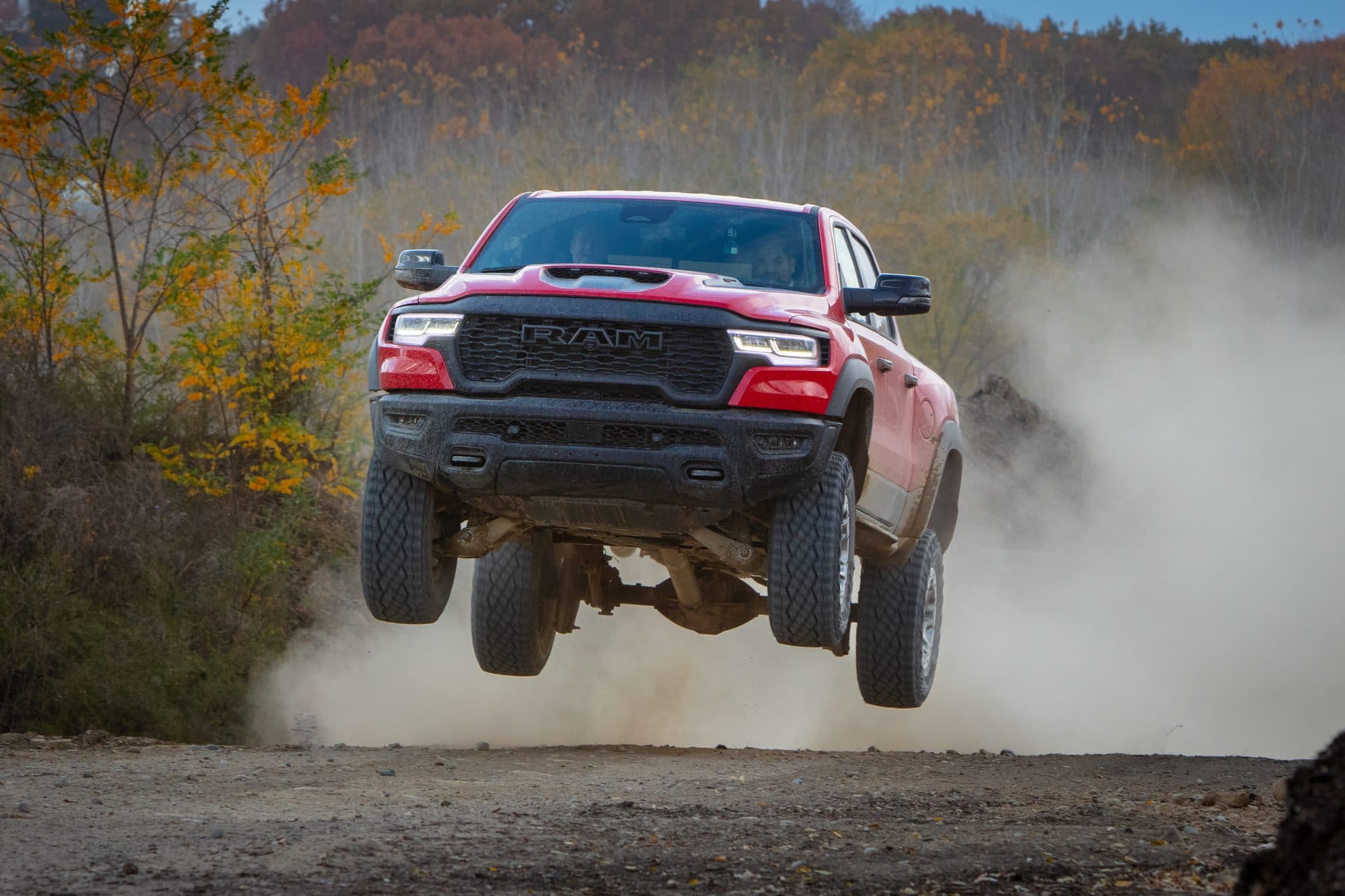
The Rebel and the RHO are not two trims of the same truck. The Rebel is a lifted, all-terrain package built on the mainstream Ram 1500, sold with your choice of gas engines and priced well under either performance truck. The RHO is a purpose-built desert runner with a 540 hp twin-turbo inline-six, factory off-road suspension tuning, and a widened stance that has more in common with the Ram 1500 TRX than with its own Rebel sibling. If you want a comfortable, easy-to-live-with off-road daily driver, that is the Rebel. If you want factory speed over rough ground and are willing to pay for it, that is the RHO.
Which Rebel are we actually comparing
"Rebel" is a trim, not a powertrain, and that trips up a lot of cross-shopping. Over its run on the current-generation Ram 1500, Rebel buyers could get a 3.6L Pentastar V6 with eTorque (a mild hybrid assist system), a 5.7L HEMI V8 with eTorque, or for a stretch, the 3.0L EcoDiesel. Ram has also reshuffled the powertrain lineup more than once around the same window that the Ram 1500 RHO launched, so what is actually sitting on a Rebel window sticker depends heavily on model year.
For this comparison we are talking about the 5.7L HEMI eTorque Rebel, since it has been the volume seller and the version most people mean when they say "Rebel" in the same breath as a TRX-adjacent truck. If you are looking at a Rebel with the V6 or the diesel, most of the character differences below still hold, but confirm the exact engine on your specific build sheet before you compare numbers.
Powertrain character: turbocharged six versus mainstream V8
The RHO's numbers are settled and public: a 3.0L twin-turbocharged Hurricane High-Output inline-six making 540 hp and 521 lb-ft, backed by an 8-speed automatic. That engine replaced the supercharged 6.2L HEMI when Ram pulled the TRX from the lineup for the 2025 model year; the TRX name came back for 2027 as the Ram 1500 SRT TRX, so the two performance trucks now sell side by side rather than one replacing the other.
The Rebel's 5.7L HEMI eTorque has, for most of its production run, been rated at roughly 395 hp and 410 lb-ft on Ram's own spec sheet. Treat that as a starting point, not gospel. Confirm the number for your exact model year against Ram's current build-and-price, because output on this engine has shifted slightly across the years and Ram has changed Rebel's available engines more than once.
The gap that matters is not the raw number, it is where the power comes from. The RHO's turbocharged six builds boost and holds torque across a wide band, which is why it feels closer to the old supercharged TRX in real driving than a spec sheet suggests. The Rebel's HEMI is naturally aspirated (aside from the light eTorque assist), which means a more linear, predictable pull with no boost to manage, and generally easier long-term ownership since there is no supercharger or turbo hardware to eventually service.
Suspension and travel: mild lift versus factory desert tuning
This is where the two trucks actually split.
The Rebel ships with roughly an inch of lift over a standard Ram 1500, monotube shocks, skid plates, and all-terrain tires in the 33-inch range. It is tuned for washboard roads, moderate trails, and a nicer ride on broken pavement. It is not tuned to be driven fast over rough ground for sustained stretches, and Ram never marketed it that way.
The RHO gets factory-tuned dampers with meaningfully more wheel travel than the Rebel, along with a widened track and flared fenders to clear larger tires, the same basic formula the TRX used before it. That is the whole point of the RHO: a truck engineered to survive high-speed desert running from the factory, not a truck with a taller ride height bolted onto a highway suspension.
If you own either truck and want more adjustability, both platforms have real aftermarket support. The Foutz Adjustable Rear Suspension Kit for TRX and RHO is one of the more common upgrades owners run to dial in ride height and travel beyond what either truck ships with from the factory. There is no equivalent expectation on a Rebel, because the Rebel was never built to need it.
Width and usability as a daily truck
The Rebel keeps the standard Ram 1500's body width. It parks in a normal garage stall, fits through a standard car wash, and does not draw a second look from the guy backing into the spot next to you.
The RHO does not. Like the Ram 1500 TRX before it, the RHO wears flared fenders and a widened stance to clear its off-road tires, which means a tighter fit in a lot of garages and parking structures, and a truck you think about differently before you back it into a downtown spot. That width buys real off-road stability at speed. It also means the RHO is a worse fit than the Rebel for someone whose "off-road truck" spends 90 percent of its life doing school runs and Costco trips.
The price gap, and what it actually buys
Ram's build-and-price for the current RHO is the number to check directly, since trim and option pricing shifts and this site does not carry a confirmed live-market average for RHO the way it does for TRX. The Ram RHO price and specs page tracks that in more detail than makes sense to restate here.
What is confirmed is where the supercharged side of the family sits. Used TRX pricing on this site's own live market data currently averages $69,505 for 2021 trucks, $75,944 for 2022, $84,930 for 2023, and $94,560 for 2024, and the new Ram 1500 SRT TRX starts at $99,995 plus $2,595 destination, with used listings already averaging $110,340. The Rebel starts tens of thousands of dollars below either the RHO or the TRX family, which is the whole reason it exists as a trim rather than a halo model.
What the extra money on the RHO buys you: a forced-induction engine with real headroom, a factory suspension built for speed instead of comfort, and a wider stance that only matters if you actually run terrain fast enough to need it. If your off-roading is mellow trails and gravel roads, you are paying RHO money for capability you will not use, and the Rebel gets you 90 percent of the outdoor truck experience for a lot less.
The verdict, by buyer
This part is judgment, not measurement, so weigh it against how you actually drive.
- Daily driver that occasionally sees dirt roads and light trails: Rebel. Easier to park, easier to live with, and the naturally aspirated V8 is a known quantity with less to eventually go wrong under boost.
- Buyer who wants factory speed over rough terrain and does not want to shop the supercharged trucks: RHO. It is the closest thing Ram sells to TRX character at a lower entry point, with a different powertrain personality.
- Buyer actually torn between a used TRX and a new RHO rather than between RHO and Rebel: that is a different comparison with its own tradeoffs around supercharged character versus turbocharged efficiency, covered in TRX vs RHO: the honest comparison.
- Buyer set on the supercharged truck specifically, deciding between a used 2021-2024 TRX and waiting for a 2027 SRT TRX: start with the Ram 1500 TRX model year guide before you look at either Rebel or RHO pricing at all.
The short version
- The Rebel is a mild-lift, all-terrain trim on the standard Ram 1500, not a factory desert truck.
- The RHO is a purpose-built off-roader with a 540 hp/521 lb-ft turbocharged six, factory desert suspension, and a widened stance closer to TRX than to Rebel.
- Confirm which Rebel engine you are actually looking at before comparing numbers, since the trim spans several powertrains across its run.
- The price gap buys forced-induction power and factory suspension travel on the RHO. If you do not run terrain fast enough to use that, the Rebel gets most of the real-world capability for a lot less money.